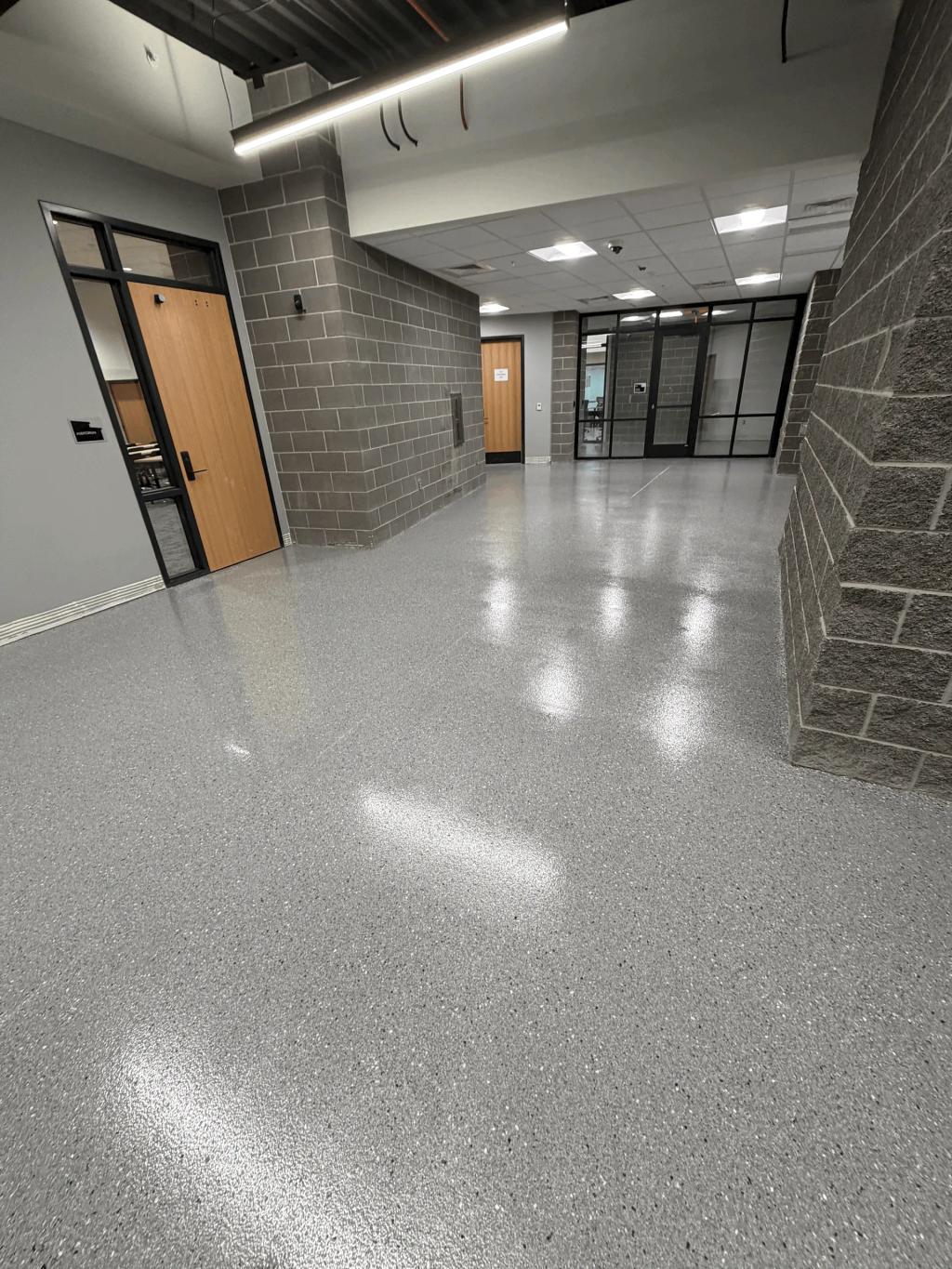

Seamless floor coating vs quarry tile or VCT
Tile has been the default in kitchens and VCT in schools and stores for decades. A seamless resin floor trades joints and waxing for one continuous surface.
How each option works
Quarry tile is a dense, unglazed clay tile set in mortar with grout joints, long used in commercial kitchens because it handles heat and wear.
Vinyl composition tile, or VCT, is a thin resilient tile glued to the slab and protected by layers of floor finish that are stripped and reapplied over time.
A resinous coating is installed directly on prepared concrete as one seamless layer. Depending on the space it may be urethane cement, epoxy with flake or quartz, or a decorative system, usually with an integral cove base where the floor meets the wall.
Side by side
| Seamless resin coating | Quarry tile or VCT | |
|---|---|---|
| Joints and seams | One continuous surface | Grout lines or tile seams across the floor |
| Water and liquids | Sealed surface; cove bases keep liquids from walls | Grout and seams can let water through |
| Routine upkeep | Clean with a scrubber; no stripping or waxing | Quarry grout needs scrubbing; VCT needs regular strip and wax |
| Repairs | Damaged areas can be patched and top coated | Cracked tiles are replaced one by one |
| Comfort and sound | Hard surface, similar to concrete | VCT is slightly softer; quarry tile is hard |
| Install disruption | Prep and cure time; can be phased | Tile setting and grout cure; VCT installs quickly |
| Appearance | Solid colors, flake, quartz or metallic | Classic tile look; wide VCT color range |
Where each one wins
A seamless coating wins wherever joints are a problem: wet kitchens where grout erodes and holds grime, restrooms, locker rooms and anywhere sanitation matters.
It also removes the strip-and-wax cycle that VCT needs, which is a recurring labor cost.
Quarry tile still makes sense where an existing tile floor is sound and a facility prefers its familiar look and replaceable units. VCT can be a reasonable choice for dry areas where a quick, low-cost install matters more than long-term upkeep.
Urethane cement flooring →Flake floor coatings →Quartz floor coatings →
Where each one struggles
Quarry tile's weak point is its grout: it wears, cracks and absorbs grease, and loose or broken tiles become trip points.
VCT struggles in wet areas, where water can creep under seams and loosen the adhesive, and its look depends on keeping up with waxing.
Coatings rely on proper prep and a dry enough slab, and the install closes the area while it cures. Going over existing tile is sometimes possible but often means removing it first, which adds to the scope.
What affects the cost
Up-front cost depends heavily on what is coming out.
Removing quarry tile and its mortar bed, or VCT and its adhesive, is often a large part of the project, along with leveling the slab afterward.
Over the life of the floor, maintenance matters as much as install. VCT's waxing schedule and quarry tile's grout repairs are ongoing costs that a seamless floor largely avoids.
- Demolition of tile, mortar bed or adhesive
- Slab leveling and repairs after removal
- Cove base and drain detailing
- Ongoing waxing, stripping or grout work
- Phasing around service or class schedules
Which to choose by space
Restaurant kitchens and food processing rooms often move from quarry tile to urethane cement to get rid of grout lines.
Schools, clinics and retail back rooms often replace VCT with a seamless coating to stop the wax cycle.
Front-of-house retail and offices can go either way depending on the look wanted and how much maintenance the staff can keep up with.
Restaurant and commercial kitchen floors →School and university floors →Grocery store floors →
The verdict
Weigh the cost to install against the cost to keep the floor clean and intact.
- Wet, greasy or sanitary areas: seamless coating
- Tired of stripping and waxing: seamless coating
- Sound existing tile you like: keep and maintain it
- Dry area on a tight up-front budget: VCT may still fit
- Hot kitchen replacing quarry tile: urethane cement
FAQ
Coating vs tile or VCT: questions
Straight answers to the questions we hear most.
Can a coating go directly over quarry tile or VCT?
Sometimes over well-bonded quarry tile, with careful prep, but it can telegraph grout lines and depends on the tile's bond. VCT is almost always removed, since coatings do not bond reliably to vinyl and adhesive.
Does a seamless floor meet food-safety expectations for kitchens?
The FDA Food Code generally asks for floors that are smooth, durable, nonabsorbent and easily cleanable, which seamless resin floors are designed to be. Local health inspectors make the final call for each site.
Is a coated floor harder to stand on than VCT?
Coatings are as hard as the concrete beneath, similar to quarry tile and a little firmer than VCT. Anti-fatigue mats are common at workstations either way.
How disruptive is replacing tile with a coating?
Removal is noisy and dusty, and the coating needs cure time. Work is usually phased by area or scheduled after hours to keep the business running.
Related
Keep reading
- IndustriesRestaurants & kitchensSeamless, slip-resistant kitchen floors installed overnight or on your closed day.Read more →
- GuidesRestaurant floors and food codeWhat food-safety rules generally ask of kitchen floors, and how seamless coatings meet them.Read more →
- SystemsUrethane cementA heavy-duty floor for hot washdown, steam cleaning and thermal shock.Read more →
- ComparisonsEpoxy vs urethane cementTwo seamless systems compared for heat, washdown, chemicals and appearance.Read more →
- CommercialRequest a bidSend the building, size and timing for a written bid.Read more →

Request a bid
Ready for a bid?
Send your project details or plans. We reply within 1 business day.