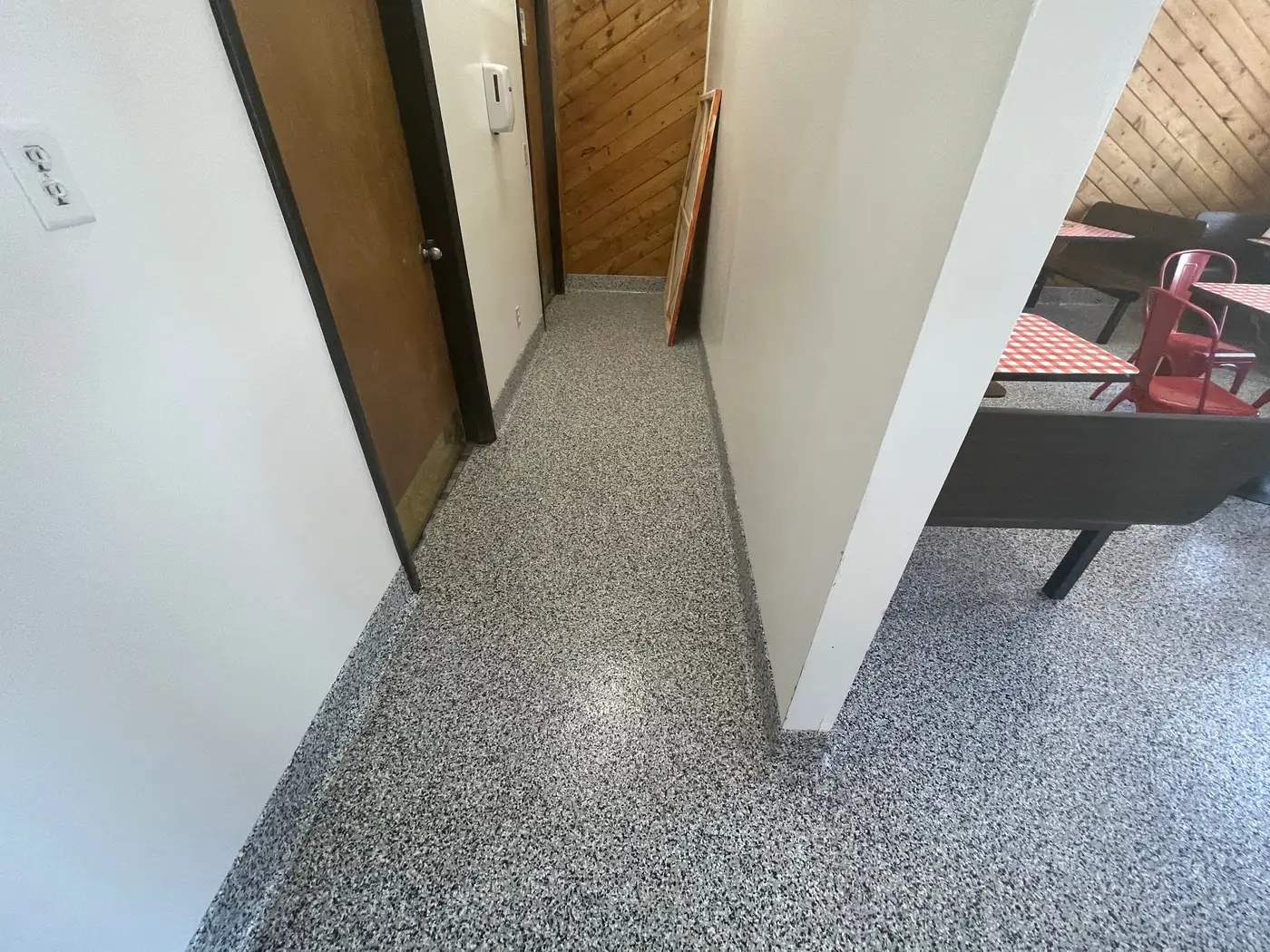

Polyaspartic floor coatings
Polyaspartic coatings cure quickly and hold their color in sunlight, which makes them a strong fit when a business cannot close for long.
What polyaspartic is
Polyaspartic is a type of aliphatic polyurea, a coating chemistry that cures much faster than traditional epoxy.
It can be used as a full system or as the clear topcoat over an epoxy or flake base.
Because it is aliphatic, it resists the yellowing that sunlight causes in many epoxies. That makes it a common choice for floors near large doors, storefront glass or outdoor exposure.
How it is installed
Preparation is the same as any bonded coating: grinding to open the slab, repairing cracks and checking moisture.
Polyaspartic gives installers a shorter working time, so crews mix in smaller batches and work in planned sections.
Coats can often be applied in quicker succession than epoxy, which is what shortens the overall schedule. Temperature and humidity still affect how fast each coat cures.
- Grind and clean the slab
- Repair cracks and pits
- Prime or base coat
- Optional flake or quartz broadcast
- Polyaspartic topcoat
Key properties
The headline traits are fast return to service, UV stability and good abrasion resistance.
Clear polyaspartic topcoats also tend to resist hot tire pickup and many common stains.
Fast cure means less time for bubbles to escape, so careful prep and moisture control matter even more than with slower systems.
Where it is used
Polyaspartic suits businesses that need a coated floor without a long closure, and spaces with sunlight or temperature swings.
It is often the topcoat on flake and quartz systems in public areas.
Strengths, limits and when to choose something else
Its strength is speed: many spaces can return to use sooner than with an all-epoxy system.
The trade-off is a shorter working window and a material cost that is often higher than standard epoxy.
For hot washdown, steam cleaning or heavy thermal shock, urethane cement is usually the better system. For thick, heavy-duty base layers, epoxy is still commonly used underneath a polyaspartic topcoat.
Care and maintenance
Routine sweeping and damp mopping with a pH-neutral cleaner keep the surface clear.
Walk-off mats at entries cut down on the sand and grit that scuff glossy finishes.
When a high-traffic area starts to look dull, the floor can usually be lightly abraded and given a fresh topcoat.
At a glance
| Property | What to expect |
|---|---|
| Look | Clear or pigmented, typically high gloss |
| Cure | Fast; spaces often return to use sooner than epoxy |
| Sunlight | UV-stable, resists yellowing |
| Durability | Good abrasion and stain resistance |
| Install window | Short working time, done in planned sections |
| Upkeep | Neutral cleaner, recoat dull lanes |
FAQ
Polyaspartic: questions
Straight answers to the questions we hear most.
Is polyaspartic the same as polyurea?
Polyaspartic is a member of the polyurea family, modified so it cures at a workable pace. Pure polyurea sets far too quickly for most floor work, which is why polyaspartic is used instead.
Can a polyaspartic topcoat be added to an epoxy floor that is already down?
Often yes, if the existing coating is well bonded. The old surface is abraded and cleaned so the new topcoat can grip; a coating that is peeling has to come off first.
Does a faster cure mean a weaker floor?
No. Cure speed is about chemistry, not strength. The finished film is hard and abrasion-resistant; the speed mainly shortens the time the space is closed.
Is polyaspartic good near open garage doors?
Yes. Because it resists yellowing in sunlight, it is a common topcoat for service bays and entries that get daylight. Grit can be added for footing where snow and water are tracked in.
Related
Keep reading
- SystemsSolid epoxyA seamless, single-color epoxy floor for warehouses, shops and service areas.Read more →
- SystemsFlake coatingsA textured, multi-color coating that hides scuffs and suits busy staff and service areas.Read more →
- ComparisonsPolyaspartic vs epoxyFast-curing polyaspartic and build-friendly epoxy compared on downtime, UV and wear.Read more →
- GuidesPhased installs and downtimeHow floors are coated in zones, at night or during shutdowns so the business stays open.Read more →
- IndustriesAuto shops & dealershipsBay floors that resist hot tires and fluids, and showroom floors that look sharp.Read more →

Request a bid
Ready for a bid?
Send your project details or plans. We reply within 1 business day.