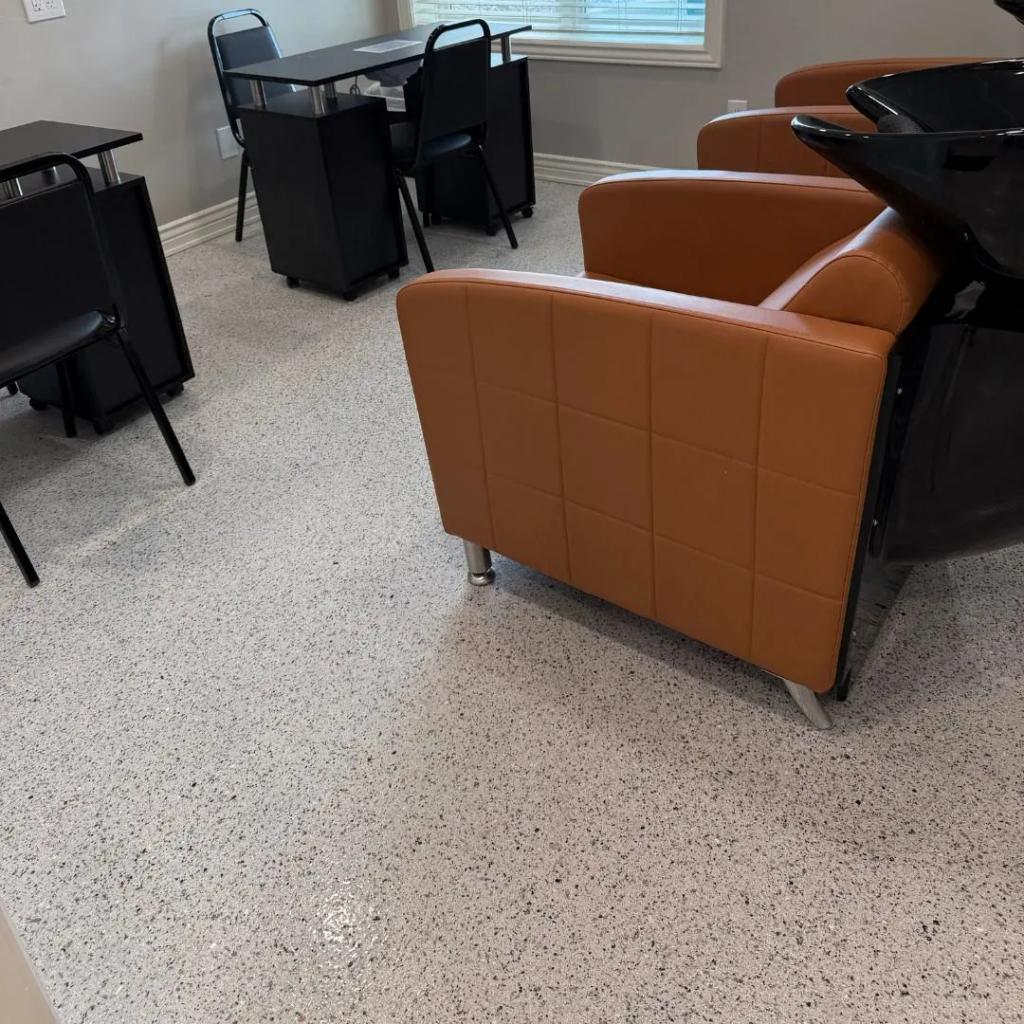

Polyaspartic vs epoxy for commercial floors
The biggest practical difference is downtime: polyaspartic cures much faster than epoxy. Durability, sunlight and budget fill in the rest of the decision.
How each one works
Epoxy is a two-part resin that cures slowly into a hard, well-bonded layer.
Its slow cure gives it time to wet into the concrete and level out, which is why it is so common as a primer and base coat.
Polyaspartic is a type of aliphatic polyurea that cures far faster and stays color-stable in sunlight. It is used as a full system on its own or, very often, as the clear top coat over an epoxy base with flake or quartz.
Side by side
| Polyaspartic | Epoxy | |
|---|---|---|
| Cure speed | Fast; shorter closure for the space | Slower; space stays closed longer |
| Sunlight and UV | Holds color without yellowing | Can amber or yellow under UV |
| Abrasion and scratches | Strong scratch and abrasion resistance as a top coat | Hard, but the surface scuffs more readily |
| Build and leveling | Thinner coats; less forgiving on rough slabs | Builds thicker and levels small flaws well |
| Installation window | Short working time; needs an experienced crew | Longer working time; more forgiving to install |
| Odor and conditions | Sensitive to heat and humidity during install | Sensitive to cold during cure |
| Typical cost position | Generally higher material cost | Generally lower material cost |
Where each one wins
Polyaspartic wins when downtime is expensive: storefronts, dealership service drives, clinics and any space that must reopen quickly.
Its UV stability also suits areas near overhead doors, windows and storefront glass, and its abrasion resistance helps in busy walkways.
Epoxy wins as a thick, forgiving base, on slabs with minor surface flaws, and where budget matters most. It is also well suited to interior warehouses and production areas where sunlight is not a concern and closing a zone for longer is acceptable.
Polyaspartic coatings →Solid epoxy floor coatings →Flake floor coatings →
Where each one struggles
Polyaspartic's fast cure leaves little working time, so large areas, hot weather and inexperienced crews can lead to lap marks or poor wet-out.
Applied directly to a poorly prepped slab, it can lose its bond just like any coating.
Epoxy's longer cure means the space stays out of service longer, and in cold buildings the cure slows further. Without a UV-stable top coat, it can yellow in sunlit areas.
What affects the cost
Polyaspartic material generally costs more than epoxy, but the savings in closed days can outweigh it for businesses that lose revenue while the floor is down.
The common hybrid, an epoxy base with a polyaspartic top coat, balances the two.
As with any coating, prep, repairs, moisture conditions, decorative broadcast and after-hours scheduling all affect the final price.
- Cost of keeping the space closed
- Full polyaspartic versus epoxy base with polyaspartic top coat
- Flake or quartz broadcast
- Slab repairs and moisture mitigation
- Night, weekend or phased work
Which to choose by space
Dealerships, franchise locations, retail stores and clinics that need to reopen quickly often favor polyaspartic or a polyaspartic top coat.
Fire stations and fleet garages with open bay doors benefit from its UV stability too.
Warehouses and manufacturing floors that can close a zone for longer often favor epoxy for its build and value, sometimes with a tougher top coat in traffic lanes.
Auto shop and dealership floors →Franchise and multi-location floors →Manufacturing floor coatings →
The verdict
In many commercial floors the answer is not one or the other but both, each where it works best.
- Must reopen fast: polyaspartic
- Sunlight through doors or windows: polyaspartic top coat
- Thick, forgiving base over an imperfect slab: epoxy
- Tightest budget with flexible downtime: epoxy
- Best of both: epoxy base, polyaspartic top coat
FAQ
Polyaspartic vs epoxy: questions
Straight answers to the questions we hear most.
Is polyaspartic stronger than epoxy?
Polyaspartic usually resists abrasion and UV better, while epoxy builds thicker and bonds well as a base. Strength depends on the full system, not one product.
Can polyaspartic go over an existing epoxy floor?
Often, if the epoxy is well bonded. It is cleaned and abraded first so the new top coat can bond to it.
Why do some contractors avoid full polyaspartic systems?
Its short working time makes large areas harder to install well, especially in heat. Many prefer an epoxy base with a polyaspartic top coat for that reason.
How much faster can a polyaspartic floor reopen?
Polyaspartic generally allows foot and vehicle traffic much sooner than epoxy. The exact timing depends on the product, temperature and humidity on the day.
Related
Keep reading
- SystemsPolyasparticA fast-curing, UV-stable coating for spaces that need to reopen quickly.Read more →
- SystemsSolid epoxyA seamless, single-color epoxy floor for warehouses, shops and service areas.Read more →
- GuidesPhased installs and downtimeHow floors are coated in zones, at night or during shutdowns so the business stays open.Read more →
- IndustriesAuto shops & dealershipsBay floors that resist hot tires and fluids, and showroom floors that look sharp.Read more →
- CommercialRequest a bidSend the building, size and timing for a written bid.Read more →

Request a bid
Ready for a bid?
Send your project details or plans. We reply within 1 business day.