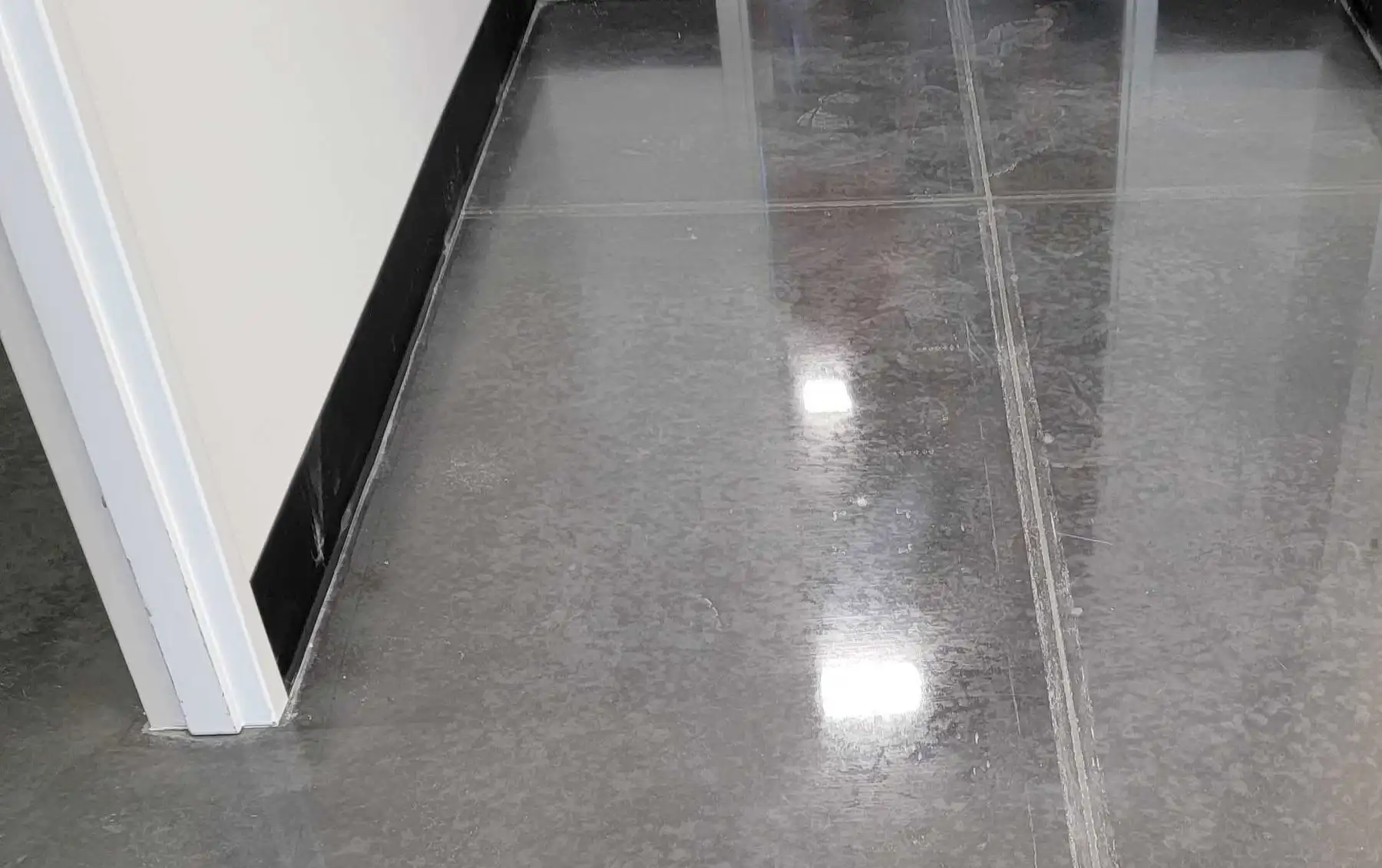

Concrete joint fill
Filling control and construction joints supports their edges so forklift and cart wheels roll over smoothly instead of chipping them apart.
What joint fill is
Slabs are cut or built with joints so they crack in planned lines as they shrink.
Left open, those joints collect debris and their edges chip under hard wheels.
Joint fill is a semi-rigid material, usually a polyurea or epoxy, that fills the joint flush with the floor. It supports the edges while still allowing a small amount of slab movement.
How it is installed
Joints are cleaned out to sound concrete, often with a saw or joint router, and any spalled edges are rebuilt.
Filler is pumped into the joint, slightly overfilled and then shaved flush once it cures.
On slabs that are still shrinking, a joint may open again along one side. Topping up those gaps later is a normal part of joint maintenance.
- Clean joints to sound concrete
- Repair spalled edges
- Fill with semi-rigid filler
- Shave flush
- Recheck and top up as the slab settles
Key properties
A properly filled joint gives wheels a continuous surface, which reduces impact on both the slab and the equipment.
It also keeps dirt and liquids out of the joint.
Semi-rigid fillers are firmer than flexible caulks, which is why they are used where hard wheels travel.
Where joint fill is used
Joint fill matters anywhere hard-wheeled equipment crosses slab joints: forklift aisles, loading docks, production floors and hangars.
Strengths, limits and when to choose something else
Joint fill is a targeted repair that protects the slab and equipment without coating the whole floor.
It does not stop a joint from moving, and it is not designed for expansion or isolation joints that need flexible sealant.
Badly broken joints may need edge rebuilding first, and a slab with wider cracking may need a broader repair plan.
Care and maintenance
Walk the main aisles regularly and look for gaps opening along joint edges or filler sitting proud of the floor.
Small gaps are easier and cheaper to top up than chipped edges are to rebuild.
Keep joints clean during sweeping and scrubbing so debris does not pack into any new gaps.
At a glance
| Property | What to expect |
|---|---|
| Purpose | Supports joint edges under hard wheels |
| Material | Semi-rigid polyurea or epoxy filler |
| Finish | Flush with the floor surface |
| Movement | Allows minor movement; may need topping up |
| Not for | Expansion or isolation joints |
| Upkeep | Inspect aisles, refill gaps early |
FAQ
Joint fill: questions
Straight answers to the questions we hear most.
Why do warehouse joints break down?
Hard forklift wheels hit the unsupported edges of open joints thousands of times. Over time the edges chip, the joint widens and the impact gets worse.
Should joints be filled before or after a floor coating?
It depends on the system and the slab. Often joints are repaired first, the floor is coated, and the joints are re-cut and filled so they can still move.
Why did my filled joint separate along one side?
Slabs keep shrinking for a long time after they are poured. When that happens the filler can pull away from one edge, and topping up the gap is a normal fix.
Is joint fill the same as caulk?
No. Caulks are soft and flexible, which suits expansion joints but not forklift traffic. Semi-rigid fillers are firm enough to support wheels.
Related
Keep reading
- SystemsSolid epoxyA seamless, single-color epoxy floor for warehouses, shops and service areas.Read more →
- Problems we fixCracks and jointsCracks and open joints in commercial slabs, and how they are repaired before coating.Read more →
- Problems we fixForklift-damaged concreteChipped joints, ruts and worn-through coating in forklift lanes, and how they are repaired.Read more →
- IndustriesWarehouses & distributionForklift lanes, docks and aisles coated and sealed around your shipping schedule.Read more →
- IndustriesManufacturing & industrialChemical, impact and heat-resistant plant floors installed during your planned shutdowns.Read more →

Request a bid
Ready for a bid?
Send your project details or plans. We reply within 1 business day.