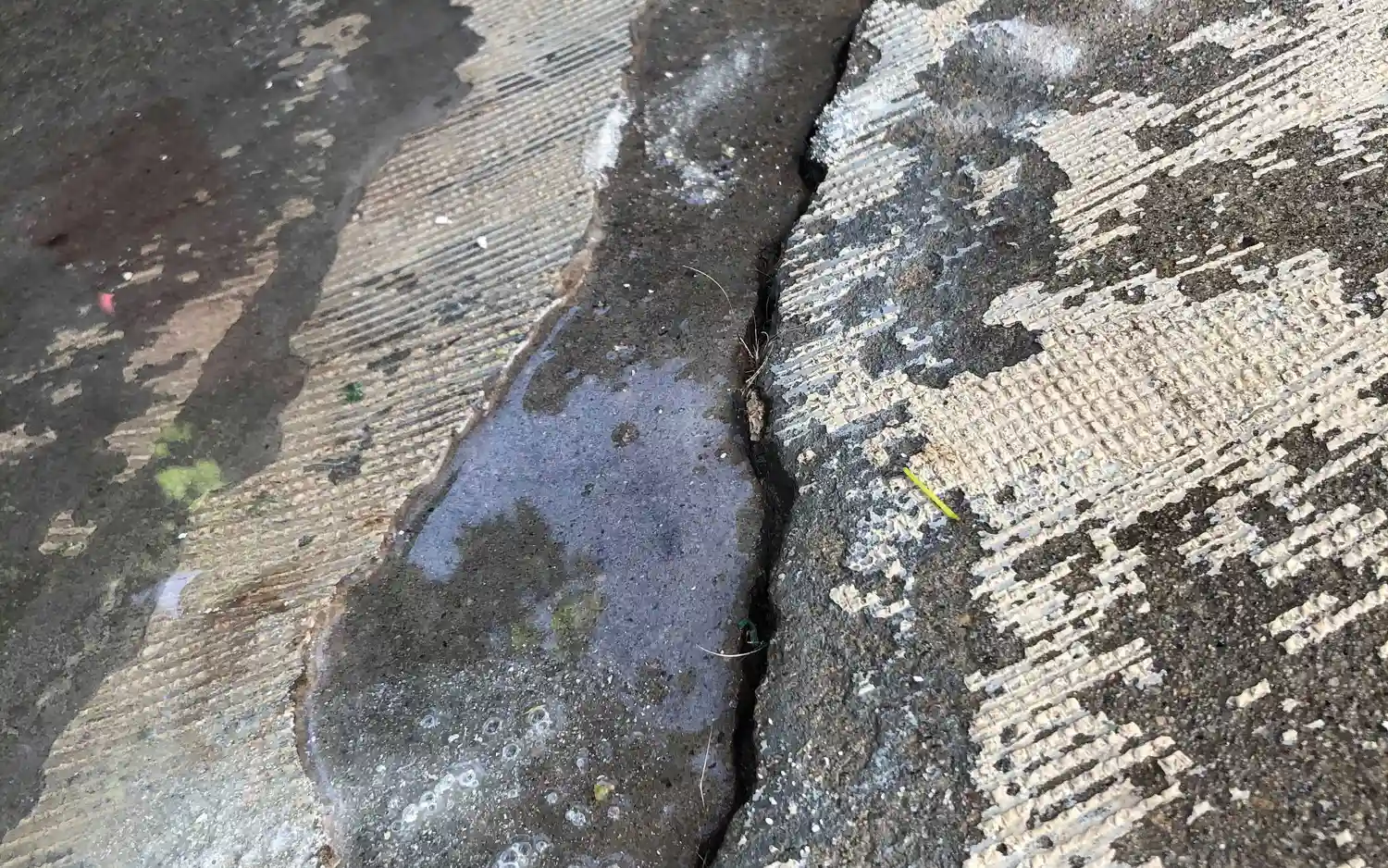

When moisture vapor pushes a floor coating off the slab
Concrete can carry moisture up from below long after it looks dry. When that vapor is trapped under a coating, it can blister and lift the floor from beneath.
What a moisture problem looks like
The classic sign is blistering: small domes in the coating, sometimes filled with liquid when they are cut open.
Other floors show cloudy or white haze, adhesive that turns soft under flooring, or wide areas where the coating sounds hollow and peels in sheets.
Moisture problems often appear on slabs without a vapor barrier underneath, on newer slabs, or in parts of a building where groundwater, irrigation or drainage sits close to the floor.
- Blisters or bubbles that keep spreading
- Hollow-sounding or lifting patches
- White haze or residue on or under the coating
- Damp darkened concrete where coating has come off
What causes it
Concrete is porous, and water vapor moves through it from the damp ground below toward the drier air above.
A dense coating slows that movement, so vapor and dissolved salts build up at the bond line and can force the coating off.
Missing or damaged under-slab vapor retarders, new concrete that has not dried enough, and changes in drainage or irrigation are common causes. Temperature swings between the slab and the room can make it worse.
Why it gets worse and what it costs
Blistering rarely stops on its own, because the moisture source is still there.
Each patch over a wet slab tends to fail again, so repeated spot repairs add up without fixing anything.
Lifted coating becomes a trip point, lets water and dirt under the floor, and in clean spaces creates seams that are hard to sanitize. Moisture can also damage flooring and goods stored directly on the slab.
How it is fixed
The repair starts with testing the slab so the moisture level is measured rather than guessed.
Failed coating is removed, the surface is mechanically prepped, and a moisture vapor mitigation layer designed to bond to damp concrete is installed before the finish system.
Once vapor is controlled, the finish can be chosen for the use of the space: solid epoxy for general areas, a decorative system for public spaces, or urethane cement where washdown and moisture tolerance both matter.
Moisture vapor barrier systems →Solid epoxy floor coatings →Urethane cement flooring →
- Test moisture before choosing a system
- Remove all failed and loosely bonded coating
- Install a vapor mitigation primer or barrier
- Apply the finish system over the barrier
How to keep it from coming back
Testing before coating is the most reliable prevention, especially on new slabs, slabs on grade without a known vapor retarder, and buildings with a history of damp floors.
On new construction, giving the slab time to dry and testing it before the floor goes down avoids most failures.
Outside the building, keep drainage moving away from the slab and check that irrigation is not soaking the ground next to the foundation.
When to call for a site visit
If blisters keep returning after repairs, or a new coating is lifting on a slab on grade, call before patching again.
A site visit includes a look at the failure pattern and moisture testing, and the written scope explains what the slab needs before any new coating.
FAQ
Moisture vapor failures: questions
Straight answers to the questions we hear most.
How do I know if moisture is causing my coating to fail?
Blisters, liquid under the coating, white residue and failures concentrated on slabs on grade are strong hints. Moisture testing of the slab confirms it.
Can I just patch the blisters?
Patches over a wet slab usually blister again because the vapor is still coming up. A lasting repair controls the moisture across the affected area.
Does new concrete need to be tested before coating?
Yes. New slabs hold a lot of water while they dry, and testing shows when the slab is ready or whether a vapor mitigation layer is needed.
Will a moisture barrier change how the finished floor looks?
No. The mitigation layer goes underneath, and the chosen finish system is installed over it.
Related
Keep reading
- SystemsMoisture vapor barrierA mitigation layer that keeps slab moisture from lifting the floor above it.Read more →
- Problems we fixPeeling floor coatingCoating that flakes, lifts or delaminates, what usually caused it and how it is redone right.Read more →
- IndustriesBuild-outs & tenant improvementsFloors bid to your budget and scheduled around your build-out.Read more →
- CommercialHow it worksFrom the first call to the final walkthrough, step by step.Read more →
- CommercialRequest a bidSend the building, size and timing for a written bid.Read more →

Request a bid
Ready for a bid?
Send your project details or plans. We reply within 1 business day.