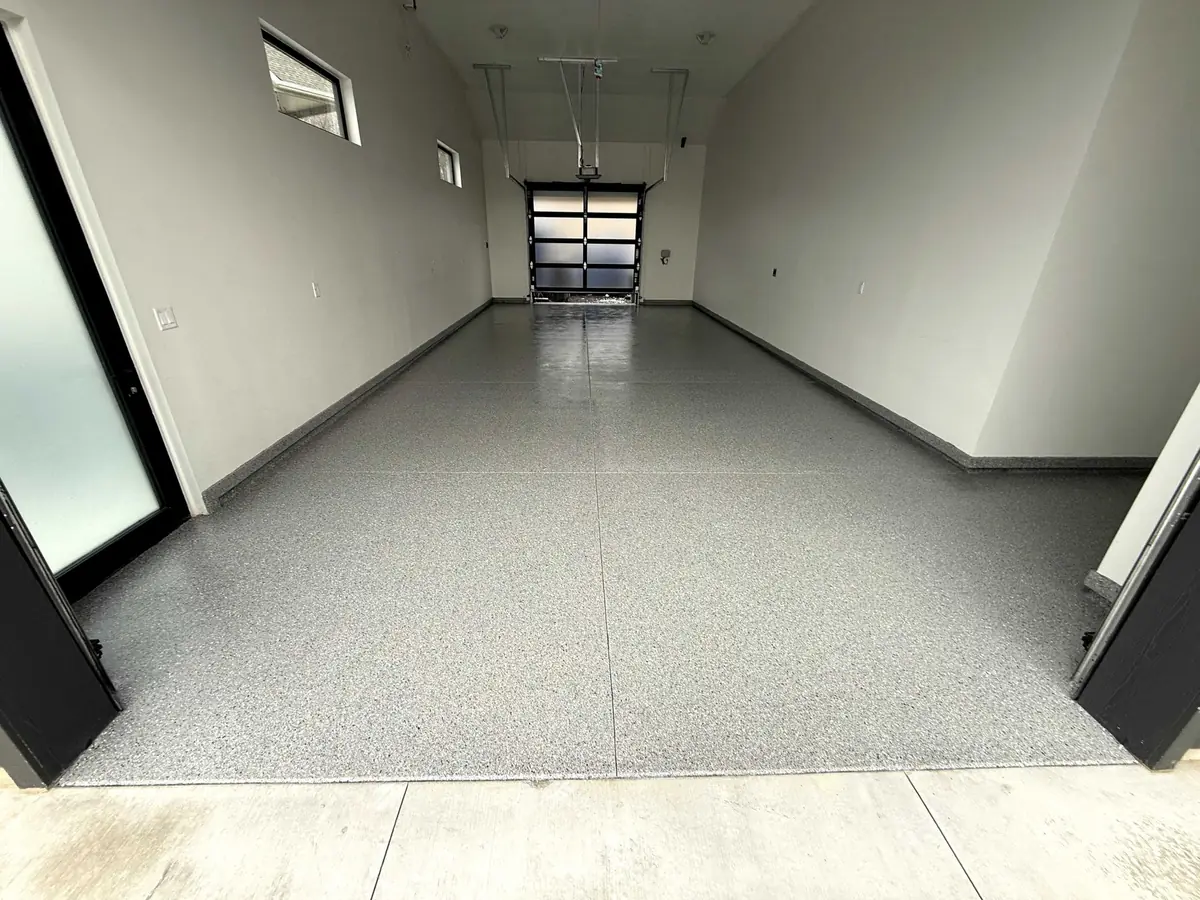
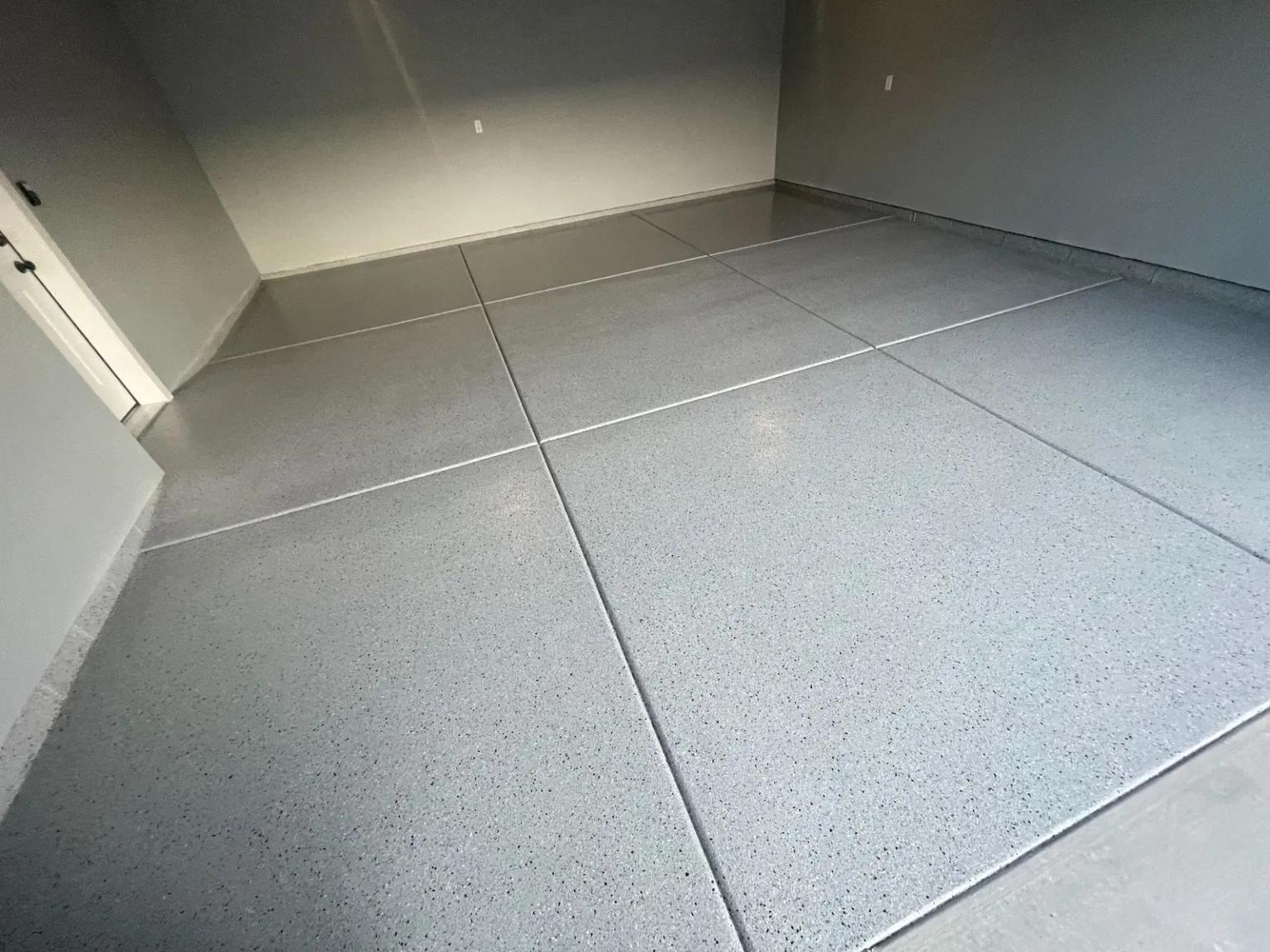
A new garage is empty, clean and free of oil drips, which is the simplest possible starting point. Once cars, shelves and boxes move in, everything has to come back out for install day. Need somewhere to put everything? We can arrange a storage container for you.
It also protects the slab from its first winter. New concrete that goes straight into a season of salty slush can start to scale near the door before it has ever been sealed.
Grey flake floor with saw-cut joints in an empty garage
Cured is not the same as dry
Concrete gains strength as it cures, but it also holds a lot of water from the original mix that has to leave the slab. A floor can be hard enough to drive on while still releasing moisture from below.
Coating over a slab that is still wet inside traps that moisture under the coating, which is a common reason floors bubble or peel. That is why a new slab is tested for moisture when it needs it, listed in the estimate, rather than going by the calendar alone.
How quickly a slab dries depends on the concrete mix, its thickness, the weather while it cures, and whether the garage is closed up and heated. A slab poured in a cold, wet season usually dries more slowly than one poured in summer.
We need new concrete to be at least 28 days old before we coat it. Builders often have a timeline in mind, but the moisture test is what confirms the floor is ready. Booking an estimate early lets the visit be planned around that result.
1Concrete mix and slab thickness
2Season and weather during the cure
3Whether the garage is enclosed and heated
4Any sealer or curing compound on the surface
Builder sealers and smooth finishes
New garage slabs are often troweled very smooth and sometimes treated with a curing compound or sealer. Both can keep a coating from gripping the concrete.
Diamond grinding removes those surface layers and opens up the concrete so the primer can bond. It is the same first step used on an old floor, which is why a new slab still needs full prep.
Hairline cracks often appear in the first months as new concrete shrinks. They are normal and are filled and ground flush before coating.
Waiting until the slab has dried properly also gives most of that early shrinkage time to show up, so it can be repaired before the floor is coated instead of after.
FAQ
Coating new concrete: questions
Straight answers to the questions we hear most.
How long do I have to wait to coat new concrete?
It depends on the slab and the weather, so there is no single number that fits every garage. A new slab is tested for moisture when it needs it, listed in the estimate, and the result decides when the floor is ready.
Can I park on my new slab before it is coated?
Usually, once the builder says the concrete is ready for vehicles. Keep drips off it with a drip tray so oil does not soak into the slab before it is coated.
My builder sealed the garage floor. Is that a problem?
Not if the floor is properly prepared. Diamond grinding removes builder sealers and curing compounds so the coating bonds to the concrete itself.
Can a new garage be coated in winter?
The polyaspartic garage system installs and cures in cold temperatures, so season is not the obstacle. Whether the slab has dried enough is what decides the date.
Ready to talk about your floor?
Request a free estimate, or see how the process works.